
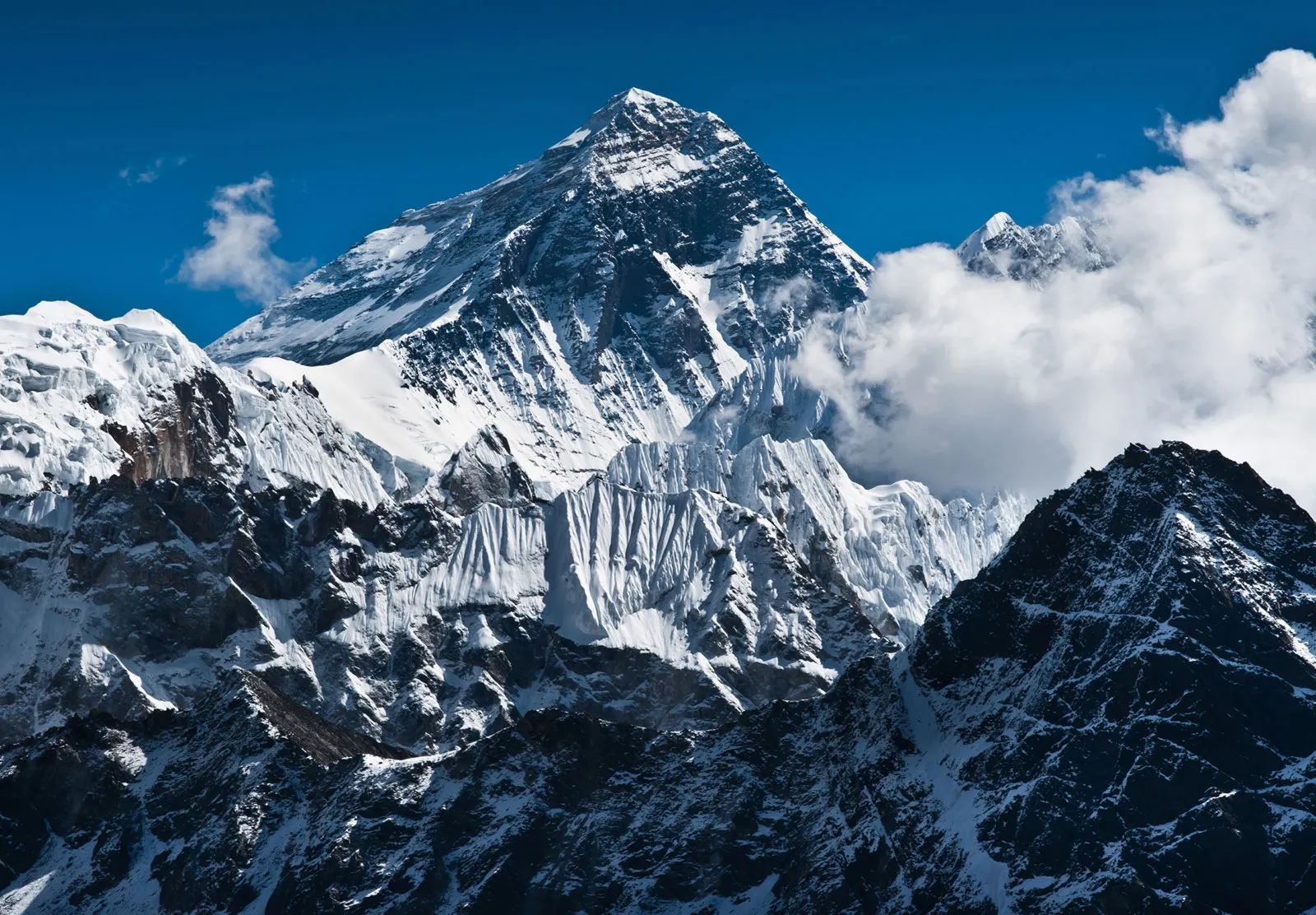
For my primary research section of the EPQ project I decided to research the ethics surrounding mountaineering, as since it is a hobby of mine it is important to know about what goes on behind the scenes. Additionally as my project was originally just going to be an article I collected data from porters and guides in Tanzania from when I climbed Kilimanjaro as this would give me a crucial insight on what really goes on.
Research methods
Primary research
To collect my primary research, I created a survey aimed at guides and porters who work on Mount Kilimanjaro. I specifically chose this group of people as in October of 2025 I climbed Kilimanjaro, so had already got some connections to my guides and porters through Instagram. They also all have first hand experience of the mountaineering industry and are able to provide a perspective that may not be available through secondary sources. The main impacts I wanted to get their views on from this survey were economic impacts, social impacts, and environmental impacts.
As all of the people I wanted to reach were living in Tanzania, I had to translate all my questions on the survey into Swahili, which is one of Tanzania’s official languages, to make the survey easier for them to participate and understand. I felt as though this was important as it allowed the participants to understand the questions clearly and may give me more accurate responses. I also translated it as I felt this would be more respectful to the participants than simply sending an English version to them and expecting them to translate it themselves. Translating it myself also meant that the questions could be understood more clearly, allowing the participants to give more accurate answers based on their own experiences. Additionally, I kept the questions relatively straightforward so that the responses would be focused on their own experiences and opinions.
I will use the primary data I collected in my survey to refer back to when evaluating different points throughout my research. This will allow me to use the opinions of the guides and porters as evidence when considering different arguments and forming my own views on the ethical, social, economic and environmental impacts of mountaineering.
Secondary research
For my secondary research I used a mixture of different sources including articles, books, academic research, databases and YouTube videos. I decided to use a variety of different sources as I wanted to get information from different perspectives rather than relying on one type of source. This was especially important for my project as the ethics surrounding mountaineering can be viewed in many different ways depending on who is giving their opinion.
I used articles to help me find more recent information about the commercialisation of mountains and the impacts that this can have on the people and environments surrounding them. I also used academic sources as these allowed me to find more detailed information and sources which had been researched in greater depth about some of the topics I was researching. Alongside this, I used books which gave me a mixture of more academic information and personal experiences from people who have actually been involved in mountaineering. I found the personal experiences useful as they gave me a different perspective compared to the more factual information found in academic sources.
I also used YouTube videos as a source of research. These were useful as they allowed me to hear people talking about their own experiences and opinions, as well as being able to see different aspects of mountaineering that may be harder to understand from just reading about them. However, I had to be more careful when using these sources as they are not necessarily produced by experts and can contain personal opinions or bias.
Throughout my research I have also had to evaluate how reliable and useful each source was. I looked at factors such as who produced the information, when it was published, what evidence was used and whether the source could have any bias. I did not want to simply use a source because it agreed with my own views, as this could make my research one sided. Instead, I tried to use different sources and compare the information between them.
The main areas I focused on through my secondary research were the economic, social and environmental impacts of mountaineering, as well as the ethical issues surrounding the increasing commercialisation of the industry. I will use the information I have collected from these sources throughout my research to help evaluate different arguments and compare them with the primary data I collected from guides and porters in Tanzania.
So what have I learnt from my secondary research?
After completing my secondary research, I have realised that there is a lot more to mountaineering than I originally thought. Before starting my EPQ, I mainly saw mountaineering as a hobby that I enjoy and something I do for the challenge. However, after researching more into the industry, I have found that there are many different factors that need to be considered. These include the economic benefits, the effects on local people, the environmental impacts and also the ethical issues that come with the sport.
One of the main things I have learnt about is how much mountaineering has changed because of commercialisation. The Hustle found that in the last 20 years Everest has had nearly a ten times increase in traffic, with more than half of the 10,055 recorded summits happening in the previous decade. [1] I found this quite surprising because it shows how quickly the mountain has changed from something that was mainly attempted by experienced mountaineers and large expeditions into something that many more people can pay to take part in. The amount of money involved also shows how commercial the industry has become, with guided Everest expeditions costing between $35,000 and $160,000, while the average Western operator charges around $66,000. [1]
This also made me think more about where all of this money actually goes and how much reaches the people doing the work on the mountain. The Hustle found that Sherpas are normally paid around $5,000 for a season, while the average Western operator charges around $66,000 per climber. [1] Obviously, the whole $66,000 would not go to the Sherpas because there are many other costs involved with running an expedition. However, I still think the difference is quite significant. It made me question whether the people taking some of the biggest risks are receiving a fair amount compared to the amount being paid by the climbers.
The risks involved with this work were another major part of my research. The Hustle found that 119 of the 304 recorded deaths on Everest were Sherpas, which is around 39%. It also explains that Sherpas can be responsible for carrying up to 60 pounds of equipment and fixing routes ahead of the climbers. [1] I found this quite concerning because people paying to climb the mountain can be paying for a service where other people are taking on some of the more dangerous jobs. This makes the ethical side of commercial mountaineering more complicated. The industry can provide employment and a good income for some people, but at the same time those mountain professionals can be exposed to much higher levels of risk.
The 2014 Everest avalanche made this even clearer to me. Sixteen Sherpas were killed while working on the mountain, and Protocol Magazine reported that the Nepalese government initially offered $400 to each family affected. After protests, this was increased to $5,000, although the article also discusses criticism about whether the money and support was actually enough. [2] I think this is one of the strongest examples of the ethical problems surrounding commercial mountaineering because it shows the difference between the amount of money involved in the industry and the support that mountain professionals and their families can receive when something goes wrong. It also made me question whether mountain professionals are being properly protected when they are such an important part of making these commercial expeditions possible.
However, I also found that it would be unfair to only look at the negative side of the money involved in mountaineering. Protocol Magazine explains that tourism accounts for around 6.7% of Nepal’s GDP and that during a successful climbing season a Sherpa guide can earn up to ten times the average annual salary in Nepal. [2] This means that although the wages may seem small compared to the amount paid by Western climbers, they can still be very important to the people working in the industry. Because of this, I do not think it would be accurate to simply say that commercial mountaineering exploits local mountain professionals. It can also provide important economic opportunities that people may rely on.
I found a similar situation when researching Mount Kilimanjaro. The World Bank estimated that Kilimanjaro tourism generates around $50 million in revenue each year and supports approximately 400 guides, 10,000 porters and 500 cooks. It also estimated that around $13 million of this revenue was reaching poorer communities around the mountain. [4] I found this particularly interesting because I have personally climbed Kilimanjaro, so I could relate these figures to what I had actually seen while I was there. It showed me that the economic benefits of commercial mountaineering are not just something that happens on Everest and can also be seen in other parts of the world.
At the same time, the World Bank also highlighted dangerous working conditions for porters and guides and environmental degradation around Kilimanjaro, particularly trail erosion during wet periods. [4] This is important because it shows that even when a mountain is generating a large amount of money for the local economy, there can still be problems happening at the same time. More people visiting the mountain can create more income, but it can also put more pressure on the mountain professionals and the environment. This is one of the reasons why I think commercialisation cannot just be looked at from an economic point of view.
The environmental side of my research has also changed the way I think about commercial mountaineering. The Hustle reported that Everest has seen nearly a ten times increase in traffic over 20 years and that there were 876 summiteers in 2019 alone. It also highlighted the amount of waste on the mountain, including oxygen tanks and human waste. [1] I found this interesting because one climber might not seem like they would have a major impact on a mountain, but when hundreds or thousands of people are doing the same thing, the overall impact becomes much larger. This means that the growth of the industry can directly increase the environmental pressure being put on these mountains.
The environmental impacts also link back to the economic side of the argument. If mountains become too damaged or overcrowded, this could eventually affect the tourism that local communities rely on. Protecting the environment is therefore not only important for ethical reasons but could also be important economically. The World Bank’s research into Kilimanjaro showed that the mountain provides large amounts of income for local people, while at the same time needing better management to deal with environmental degradation. [4] I had not really considered these two issues as being so closely connected before doing my research.
I also found some research which showed that mountaineering can have positive social impacts that I had not really considered before. One of the Guardian articles I researched looked at a climbing project in Switzerland that brought refugees together through mountaineering. The project had grown into a community of more than 200 refugees and used climbing as a way of helping people integrate and feel part of a community. [3] I found this useful because a lot of my research about Everest focused on overcrowding, money and exploitation, so this gave me a completely different perspective on what mountaineering can provide for people. It showed me that the sport is not always about reaching a summit or making money and can also have benefits for people’s communities and lives.
Another thing I learnt from my research is that the way mountains are managed can make a big difference. UN Tourism explains that mountain tourism can provide economic opportunities for local communities but also needs to consider environmental protection and the involvement of local people. [5] I think this is important because it suggests that the problem may not necessarily be mountaineering itself, but how the industry is managed. If the number of visitors increases without proper rules and management, then the negative impacts can increase as well. However, if tourism is managed properly, it can still provide jobs and income while reducing some of the damage caused to the mountain.
I have also learnt that I need to be careful about how reliable my sources are. Some of the articles I used were useful because they included statistics, interviews and real life examples, but they did not always give both sides of the argument. For example, the Protocol Magazine article was categorised as an opinion piece, so I have to consider that it may have focused more heavily on the negative treatment of Sherpas and the problems caused by commercialisation. [2] The Hustle also provided a lot of useful figures and interviewed mountaineering experts, but I noticed that some of its statistics needed to be checked against other sources. This showed me that even when a source looks well researched, I should not automatically assume that everything in it is completely accurate.
Overall, my secondary research has changed the way I look at mountaineering. I now think that there is not really a simple answer to whether commercialisation is positive or negative. It can provide large amounts of money and employment for local communities, but there are also serious questions about the wages and risks faced by mountain professionals, as well as the environmental pressure caused by increasing numbers of climbers. The main thing I have taken from my research is that these impacts are all connected. More tourists can mean more jobs and more money for local people, but it can also mean more pressure on mountain professionals and the environment. Because of this, I do not think it would be fair to say that commercial mountaineering is simply good or bad. Instead, I think how the industry is managed and how fairly the benefits are shared is more important.
I will use these different perspectives when evaluating the different arguments throughout my project and compare them with the findings from my primary research. This should allow me to see whether the information I have found from my secondary sources is similar to the experiences and opinions of the guides and porters I contacted in Tanzania.
Sources
[1] The Hustle, How Mount Everest became a multimillion-dollar business, 2024. View source
[2] Protocol Magazine, The Ethics of Summit: the Commodification of the Sherpa People, 2022. View source
[3] The Guardian, Friendship at 13,000 feet: how climbing in the Swiss Alps is bringing refugees together, 2025. View source
[4] World Bank, Tourism in Africa: Hiking Mount Kilimanjaro in Tanzania, 2013. View source
[5] UN Tourism, Mountain Tourism.
My Findings From Kilimanjaro
After collecting my primary research, I was able to use the responses from the guides and porters to get a better understanding of the different impacts that mountaineering has on the people involved in the industry on Kilimanjaro. As I had climbed Kilimanjaro myself in October 2025, I had experienced the role that the guides and porters play during an expedition first hand. This made their responses particularly valuable to me, as I already understood how important they are to the running of an expedition and had built connections with some of them through my own experience.
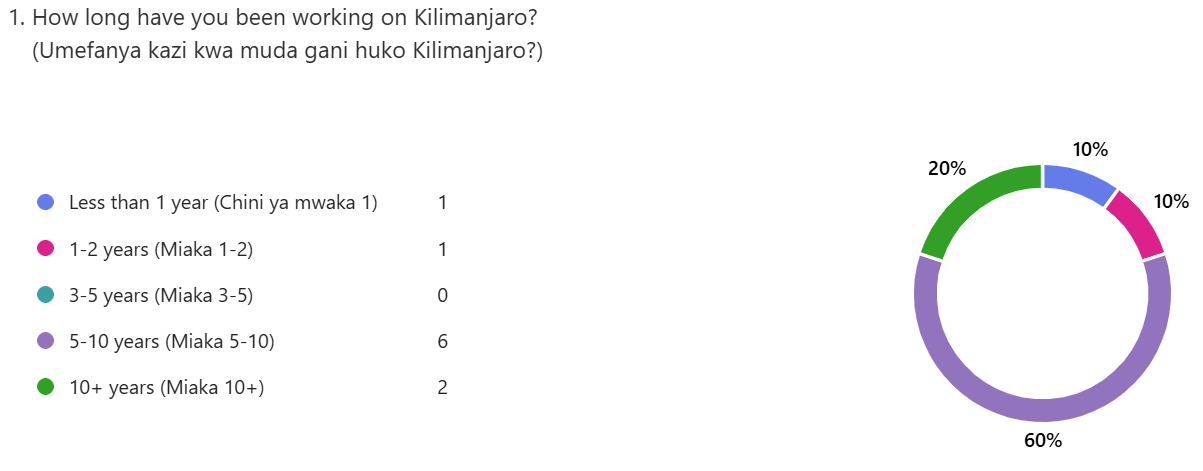
The first thing I looked at was how long the guides and porters had been working on Kilimanjaro. As shown in the results below, 60% had been working on the mountain for 5-10 years and another 20% had been working there for over 10 years. The remaining 20% had been working there for less than 2 years. I think this is useful as most of the people who responded have had several years of experience on the mountain. This means they are more likely to have seen changes in tourism and the way the mountain is used over time. However, it also means that my results may not represent the experiences of newer guides and porters as well.
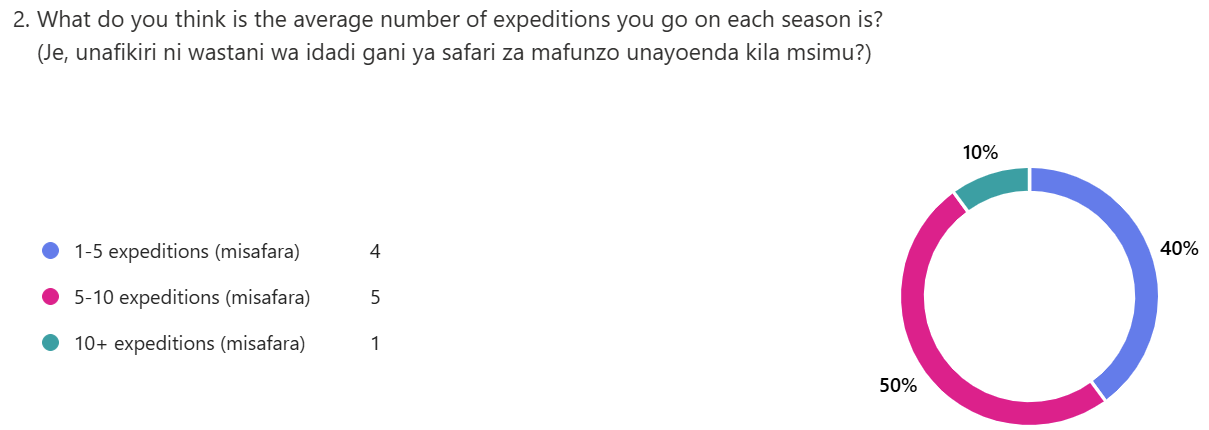
The next question looked at the average number of expeditions the guides and porters go on each season. The pie chart below shows that 50% go on between 5-10 expeditions, while 40% go on 1-5 and 10% go on over 10 expeditions. This shows that most of the people who responded are involved in several expeditions each season, meaning they regularly spend time on the mountain. I think this makes their opinions about tourism and the environment more useful as they are able to experience changes in the industry over time.
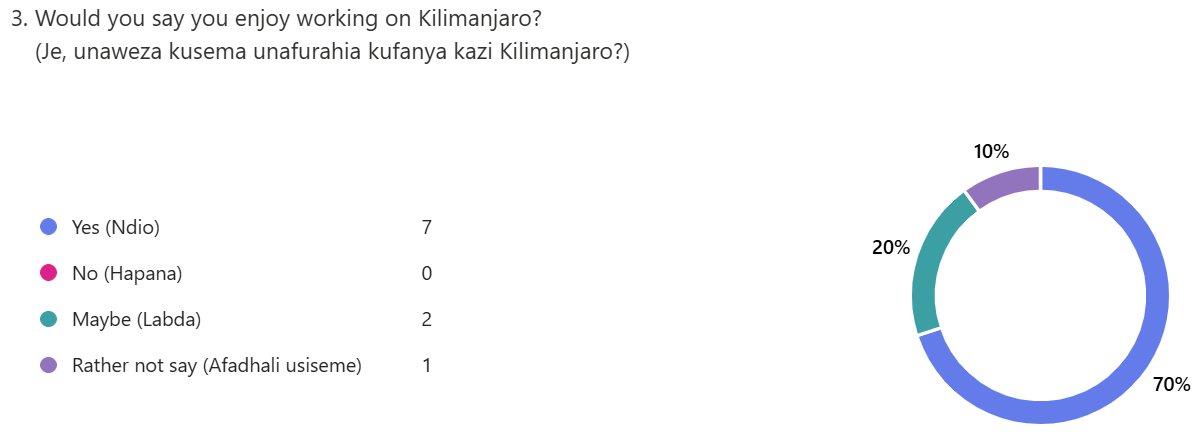
I then asked whether the guides and porters actually enjoy working on Kilimanjaro. As seen in the pie chart below, 70% said yes, 20% said maybe and 10% preferred not to say. I found this quite interesting because some of my secondary research focused on the negative side of working within the mountaineering industry. The results suggest that these problems do not necessarily mean that guides and porters dislike their work. In fact, most of the people I contacted said that they enjoy working on the mountain. This has made me think that when looking at the ethics of mountaineering, it is important not to assume that everyone involved in the industry has the same experience.
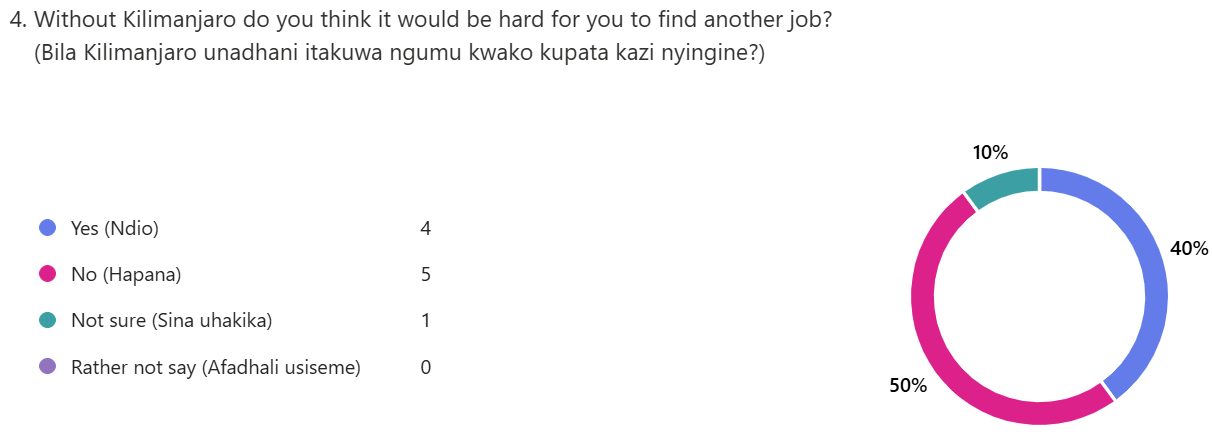
I also asked whether the guides and porters thought it would be difficult for them to find another job without Kilimanjaro. The results below show that 40% said yes, 50% said no and 10% were not sure. I found this interesting as the results were quite evenly split. This suggests that although Kilimanjaro provides an important source of employment for some people, not everyone depends on the mountain in the same way. This could mean that the economic importance of mountaineering varies between different guides and porters depending on what other opportunities are available to them.
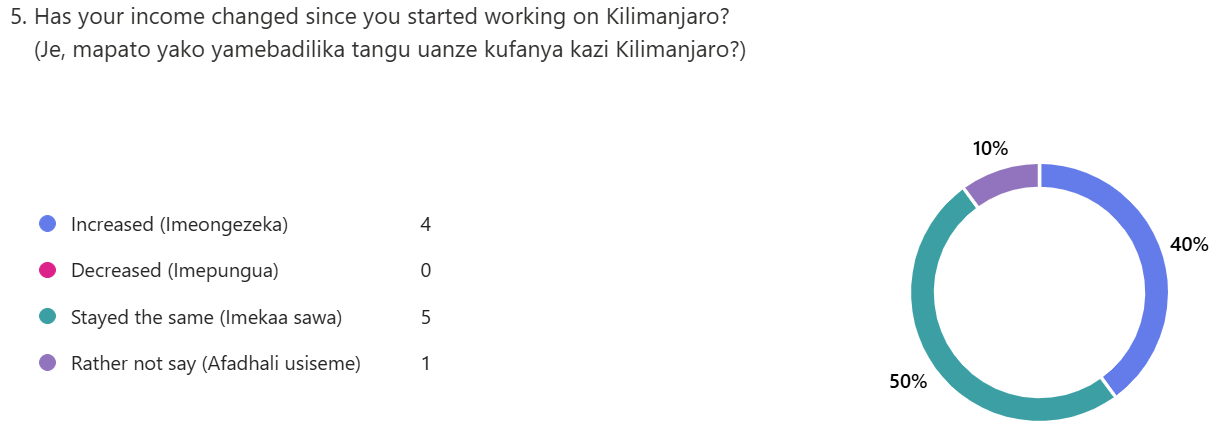
The question about income was also useful when looking at the economic impacts of mountaineering. As shown below, 40% of respondents said their income had increased since they started working on Kilimanjaro, while 50% said it had stayed the same and 10% preferred not to say. I found this particularly interesting as it does not completely support the idea that increasing tourism automatically means that the people involved in the industry will earn more money. Although some guides and porters have seen their income increase, half of the respondents said that their income had stayed the same. This makes me question whether the increasing amount of money generated by tourism is always reaching the people who help make these expeditions possible. However, as I did not ask how much their income had changed by, I cannot make a definite conclusion about how significant these changes actually were.
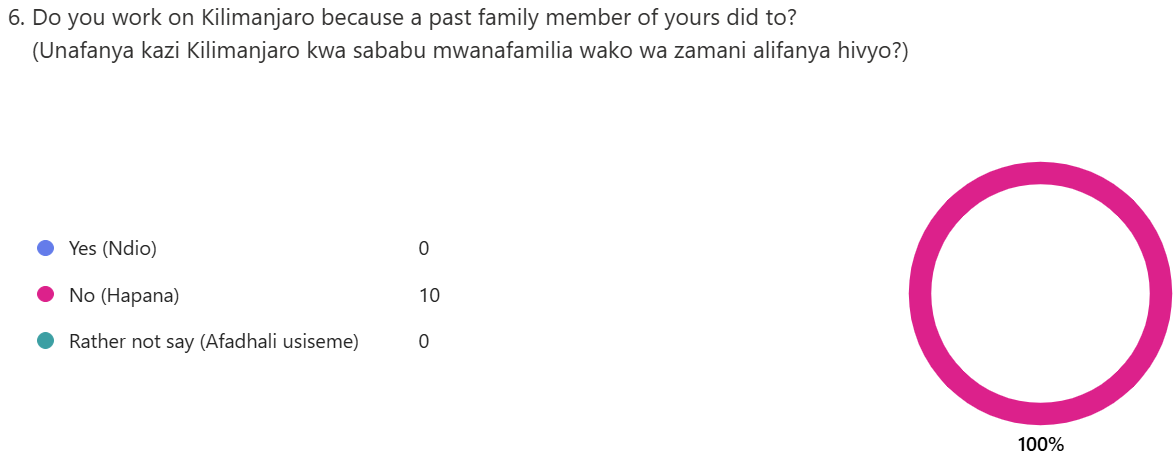
I then asked whether the respondents worked on Kilimanjaro because a previous family member had also done the same job. The pie chart below shows that 100% of respondents answered no. I found this quite surprising as I expected there to be more people who had entered the industry because of their family. Instead, my results suggest that the guides and porters I contacted had chosen this type of work for reasons other than simply continuing a family tradition. This could show that working within the mountaineering industry has become more of an employment opportunity in its own right rather than something that is automatically passed down through generations.
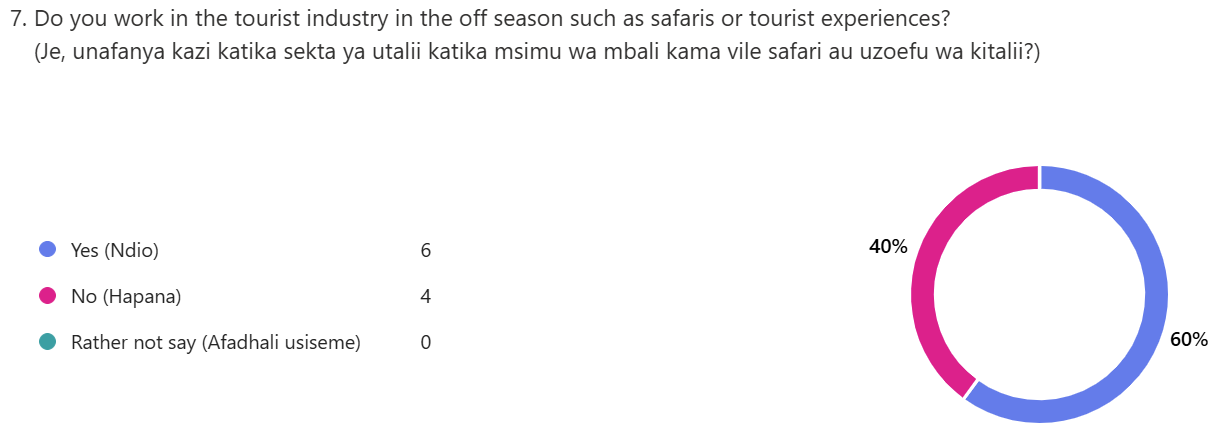
Another question looked at whether the respondents worked in tourism during the off season, such as on safaris or other tourist experiences. As shown below, the results were split exactly 50/50, with half saying yes and half saying no. I found this interesting because it shows that for some of the guides and porters I contacted, working on Kilimanjaro is only one part of their involvement in the tourism industry. This means that the economic benefits of mountaineering could extend beyond the actual climbing expeditions, as some may also earn money from other forms of tourism throughout the year. It also shows how important tourism can be as a wider industry rather than just looking at the money made directly from climbing.
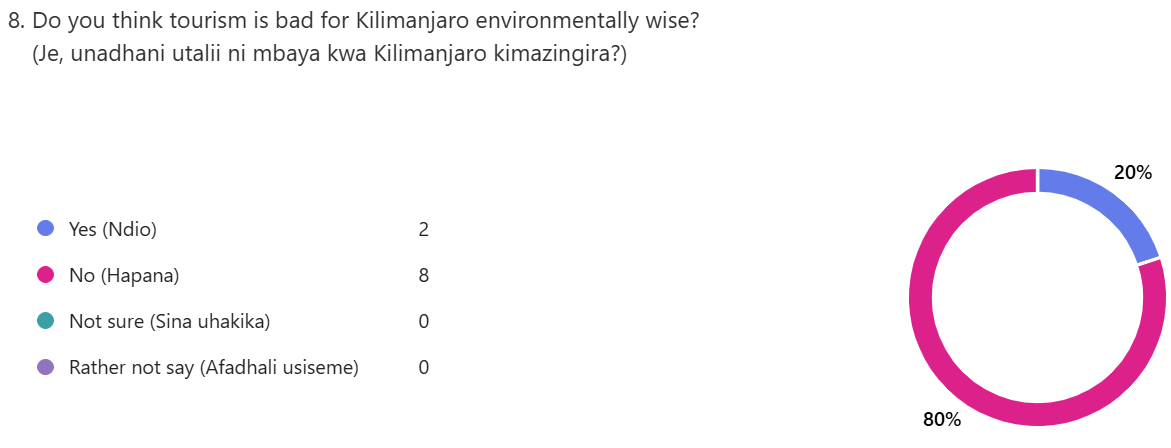
I then asked whether the respondents thought tourism was bad for Kilimanjaro environmentally. The results below show that only 20% said yes, while 80% said no. This was one of the results that surprised me the most because some of my secondary research discussed the environmental problems caused by tourism around Kilimanjaro. The World Bank, for example, identified environmental degradation as one of the issues connected with tourism around the mountain. [1] However, the guides and porters I contacted mostly did not consider tourism itself to be environmentally damaging. This could be because they see the economic benefits of tourism alongside the environmental problems, or because they have a different perspective from organisations and researchers looking at the issue from outside. I think this is important as it shows that there can be a difference between what secondary sources say and what people with first hand experience of the industry believe.
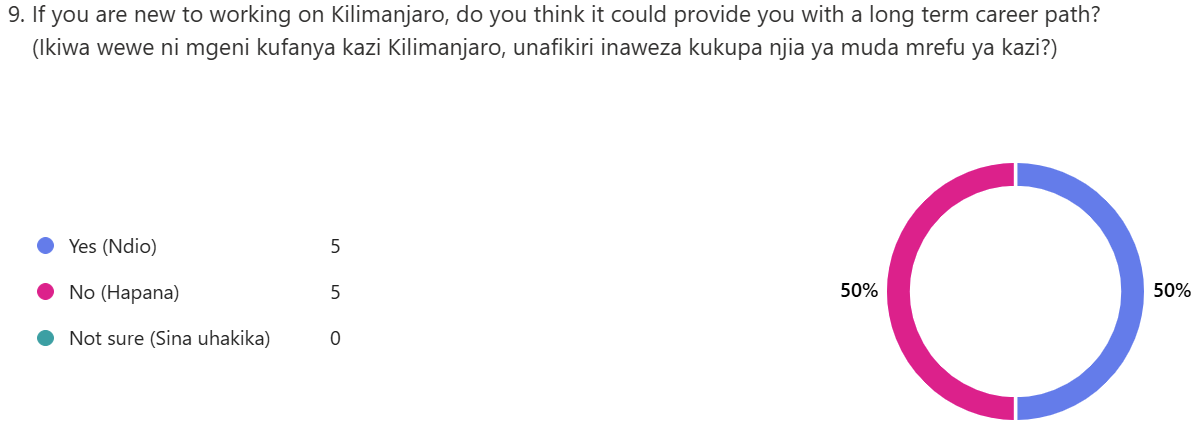
I also asked whether someone who was new to working on Kilimanjaro could use it as a long term career path. As shown in the pie chart below, 50% said yes and 50% said no. I found this interesting because there was no clear majority. This suggests that there are very different opinions about how secure working on Kilimanjaro is as a career. Some people clearly see it as something that can provide long term employment, while others do not think it provides enough security. When compared with the previous income results, where half of respondents said their income had stayed the same, this could suggest that there may be limits to how much people can progress financially within the industry.
The final question gave me probably the clearest result from my primary research. As seen below, 100% of respondents said that more regulations should be introduced to protect the mountain from damage and pollution. I found this particularly interesting when compared to the previous environmental question. Although 80% of respondents did not think tourism was bad for Kilimanjaro, every single person thought that more regulations were needed. This could suggest that the guides and porters do recognise that there are environmental issues which need to be dealt with, even if they do not believe that tourism itself is necessarily the problem. I think this is one of the most useful findings from my primary research because it shows that protecting the mountain and allowing tourism to continue do not necessarily have to be opposite ideas.
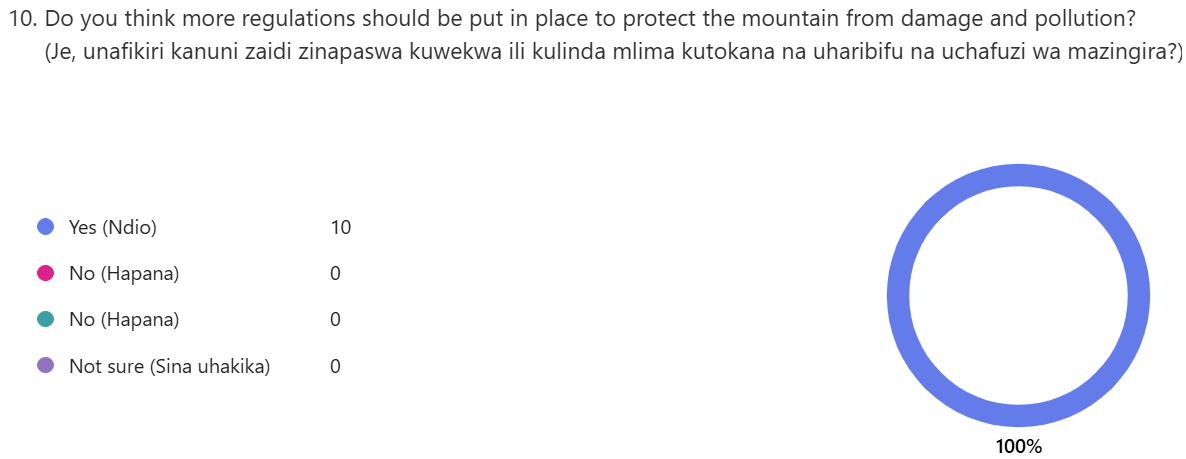
Overall, my primary research has given me a different perspective on mountaineering compared to what I found from my secondary research. A lot of the information I found online focused more heavily on the negative effects of commercialisation, while the responses from the guides and porters gave me a much more mixed view. Most of the people I contacted said that they enjoy their work and 80% did not think tourism was environmentally bad for the mountain. At the same time, the fact that 100% wanted more regulations suggests that they can still recognise that there are problems which need to be addressed.
This has changed my own view of mountaineering as I now think it is much harder to describe the industry as simply good or bad. My secondary research showed me the potential problems with commercialisation, while my primary research showed me that the people directly involved in the industry can also see benefits from it. This was particularly important to me because I had personally experienced how important the guides and porters are during an expedition. It made me realise that when discussing the ethics of mountaineering, it is important to consider their own opinions rather than only making assumptions about what is best for them.
I think this could also be important for the future of mountaineering, as tourism currently provides employment opportunities for people around mountains such as Kilimanjaro. The results from my research make me think that completely reducing tourism would not necessarily be the best solution. Instead, there could be a better balance where the economic opportunities created by mountaineering can continue while stronger regulations are used to protect the mountain. The fact that every person I contacted supported more regulations is particularly important to me, as it suggests that protecting the environment could potentially be improved without removing the opportunities that mountaineering provides to the people involved.
Sources
[1] World Bank, Tourism in Africa: Hiking Mount Kilimanjaro in Tanzania, 2013.